You already know the channels that used to drive reliable app growth are getting less reliable. Search clicks are declining as AI answers replace them, social reach is rented, paid costs keep climbing. None of that is exactly new. What's worth talking about is what it changes about where your team should be investing.
If every acquisition channel you depend on can be repriced, throttled, or restructured by someone else's algorithm, the highest-leverage thing you can build is an audience you don't need those channels to reach.
An email list isn't an owned audience
When people hear "owned audience," they tend to think of an email list. That's part of it, but at its core it’s still a single-channel asset with a single opt-in. An owned audience is the full set of users who have opted into a direct, ongoing relationship with you across any combination of channels: push notifications, email, SMS, RCS, in-app messaging, or logged-in app sessions.
A healthy owned audience has three properties.
- You can reach these users without paying an intermediary or hoping an algorithm surfaces your content.
- You have behavioral data on each user that allows you to personalize what you send and when.
- The relationship compounds over time rather than resetting every time a platform changes its rules.
That third property is the one most teams underinvest in. Every interaction a user has with your app generates signals for exactly how to retain them: what they browse, what they skip, how often they come back, which features they use. Combine that behavioral data with declared preferences (what users explicitly tell you they care about) and you have two datasets that make your messaging smarter with every cycle.
The mobile growth leaders at Surge London were emphatic on this point: user-declared preferences become first-party data you can activate across messaging, personalization, and product surfaces. The behavioral layer tells you what users actually do. Together, they form the foundation that makes an owned audience worth having.
4 ways to build an audience that sticks around
These four approaches are the ones we see working consistently across mobile teams that treat their owned audience as a strategic asset.
Let users shape their own notification experience
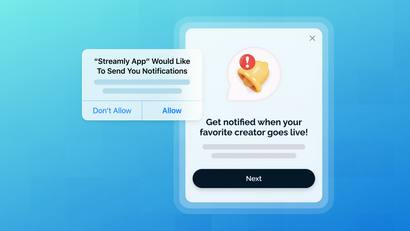
Users who feel ownership over what they receive from you are more likely to stay opted in and more likely to engage when a message does arrive. This sounds obvious, but most apps still treat notifications as a one-way broadcast: the marketing team decides what to send and when, and the user's only options are "allow" or "don't allow."
The better model is to give users real control. That means preference centers where they can choose topics, frequency settings they can adjust, and channel options that let them decide whether they want to hear from you via push, email, SMS/RCS, or some combination.
When users curate their own experience, two things happen: the messages they do receive feel more relevant (because they chose them), and you get a cleaner signal about what each person actually wants (because they told you). Both of those make your messaging more effective and your audience more durable.
Participation builds the kind of loyalty content can't
Content can be generated at scale now. Recommendations can be automated. What can't be replicated by AI is the feeling of contributing to something and having that contribution matter.
The most compelling example from the past year came from a news broadcasting team who ran live polls during on-air debates, asking fans for their predictions on the Premier League title race. The results were fed back to the pundits within the hour, influencing the follow-up discussion. That segment was then clipped for YouTube and delivered back to the fans who had participated. The users went from passive listeners to co-creators of the content, and the loop gave them a reason to come back for the next one.
You don't need a live broadcast to create participation. Polls, predictions, user-generated content, feedback mechanisms that visibly influence the product, community challenges with shared results. Any interaction where the user adds value and sees that value reflected back creates a form of investment that passive consumption doesn't. These are the kinds of experiences that leading mobile teams are building to differentiate in a world where content alone is increasingly commoditized.
Let segments breathe
Most teams segment their audience. Fewer teams build segments that can keep up with how quickly user intent actually changes. A user who was highly engaged last week might be in a quiet phase this week, and a segment that can't account for that shift will send the wrong message at the wrong time.
If your segments don't account for these natural rhythms, your messaging will feel tone-deaf: re-engagement campaigns hitting users who are in no danger of churning, promotional blasts reaching people who just converted yesterday, etc.
Your segments should have decay and exit logic built in. If a user hasn't taken a relevant action in seven days, move them out of the high-intent segment automatically and shift to a lower-frequency check-in cadence rather than continuing the same aggressive messaging. When they re-engage, let them flow back in. This kind of dynamic segmentation requires behavioral event triggers and journey logic that can respond to real-time signals, but it's what separates an audience that feels cared for from one that feels spammed.
Not every user needs every channel (yet)
Picture a first date where someone asks for your phone number, email, Instagram, and home address before the appetizers arrive. Talk about a red flag. That's what it feels like when an app asks a new user to opt into push, email, and SMS all in the same session.
A better approach is to layer channels based on where the relationship stands. A new push subscriber who hasn't given you their email yet gets value-first content designed to earn that next opt-in over time. A user who's on push and email gets coordinated cross-channel journeys that use the right channel for the right message type: time-sensitive alerts on push, longer-form content via email. A power user on push, email, and SMS gets the full orchestrated experience.
The progression should feel natural, not forced. Each channel you add gives you a new way to deliver value and a new data point about how the user prefers to engage. The goal is to build a cross-channel relationship where every message reaches the user through the medium that's most likely to be useful to them in that moment.
The metrics that tell you if it's working
Let’s sidestep these for a moment: open rates, click-through rates, conversion per send. Those matter, but they tell you how individual messages performed. They don't tell you whether your owned audience is getting healthier or eroding over time.
The metrics that actually track audience health are different.
- Opt-in rate trends across each channel tell you whether you're growing or shrinking your reachable base.
- Multi-channel depth (what percentage of users are subscribed to two or more channels) tells you how resilient your audience is.
- Engagement by relationship tenure tells you whether users who've been subscribed for three months are still opening messages or whether they've gone quiet.
- Churn rate segmented by opt-in status tells you the most important thing of all: whether your owned audience members actually retain better than users you can't reach directly.
If that last metric doesn't show a meaningful gap, the audience isn't owned in any practical sense. It's just another list. The whole point of building direct relationships is that those relationships translate into longer retention, higher lifetime value, and more opportunities to deliver value over time. Measure accordingly.
Build the relationship layer with OneSignal
Everything described in this post (preference-driven opt-ins, participatory experiences, dynamic segmentation with exit logic, channel layering across push, email, SMS, RCS, and in-app) requires a platform that can manage cross-channel messaging from a single system with shared user profiles and real-time behavioral data.
OneSignal is built for exactly this. Our Journeys builder lets you create automated flows that respond to user behavior across channels, with branching, wait conditions, and exit rules that adapt as users move through natural engagement cycles. Dynamic segments update in real time based on custom events and user tags, so your messaging reflects what users are doing right now, not what they did last month. And every channel is managed from one dashboard with one set of user profiles, so you can layer channels thoughtfully rather than running them in silos.
One in five new apps use OneSignal. See what they're building with us.
Our 2026 State of Customer Engagement Report digs into how mobile teams are building direct audience relationships in an AI-driven landscape, including the behavioral segmentation and channel strategies that are working right now.
Get the Full Report