The biggest, most durable lifts in customer lifetime value rarely come from a single send or even campaign. These types of lifts come from the automated structure sitting underneath your campaigns. Most teams have this infrastructure sitting half-built inside the lifecycle marketing platform they already pay for. They just never finish wiring it up.
Where campaign revenue is visible and immediate; structural retention gains show up weeks later, in a cohort curve nobody's watching in real time. Below is a stage-by-stage playbook for building that structure properly, plus a straight answer on what separates real lifecycle infrastructure from a glorified send tool.
The foundational problem: Why teams mistake campaigns for lifecycle strategy
Three habits tend to cap LTV, and none of them explicitly look like negligence from the inside.
The ROAS mindset bleeds into retention work. ROAS rewards the fastest conversion, so teams default to blasting offers at anyone likely to click now. But a user pushed into converting before they've found real value churns faster and is worth less over their lifetime than one who converted a week later on their own terms. Optimizing every message for immediate lift erodes the number you actually care about.
Team metrics are siloed by design. Acquisition owns cost-per-install. Lifecycle owns open rate. Nobody owns the sequence a user actually experiences across both. The result is a user who gets a "come back!" win-back push the same day they get an onboarding email, because two teams optimized their own dashboards without seeing each other's sends.
Disconnected tools make coherence structurally impossible. When push lives in one tool, email in another, and in-app in a third, there's no single view of what a user has already been told. Fixing this is table stakes for picking the right omnichannel platform (the tools problem and the strategy problem are sometimes the same problem!)
The lifecycle playbook: A stage-by-stage guide to LTV lift
A popular misconception is that retention is a singular goal. In reality, it's four different jobs, each with its own trigger logic. Here are the best retention tactics post-install, organized by what the user actually needs from you at each point.
Stage 1: Onboarding & activation (Day 0-3) — The first impression
It’s common sense that all your new users spend their first few sessions learning your app, right? While this may be partly true, the more important process (for you, the sender) during this period is your users qualifying your app.
Don’t get caught up in trying to teach every feature. Get them to one meaningful action fast, then get out of the way. Build a short welcome sequence anchored to your core value prop, use in-app messages to nudge toward that first action, and branch based on what actually happened: a user who completed setup gets a different next message than one who stalled on step two. Treat the first 72 hours as an intent-capture window for the signals a new user gives off here (or doesn't). They should shape everything you send them for the next month, starting with data available from their very first session.
Stage 2: Habit formation (Day 4-14) — Building stickiness
Activated users aren't necessarily loyal yet! Messages triggered by something a user just did (completed a milestone, browsed a category, went idle mid-task) consistently outperform scheduled broadcasts by a wide margin because they arrive when the context is still relevant.
Reward meaningful actions to reinforce the habit, use push to surface genuinely new information rather than generic reminders, and layer in secondary features only once someone has clearly mastered the core loop. If you haven't audited which of your sends are behavior-triggered versus date-triggered, start there. It's usually a smaller share than teams expect. Building this logic on top of real product events is what makes it possible.
Stage 3: Long-term engagement (Day 15–30+) — Sustaining value
Engaged users can still go quiet if nothing changes. This stage is about proactive relevance: contextual feature announcements instead of blanket ones, feedback surveys that make long-tenured users feel heard rather than farmed for data, and segmentation based on actual long-term behavior rather than acquisition cohort.
This is where automation usually compounds. Apps running structured Journeys see an average 13.6% lift in 30-day retention, and case studies from OneSignal customers have shown activity gains as high as 66% after building out onboarding-through-engagement sequences.
For more tactical depth on this window specifically, see retention strategies post-onboarding.
Stage 4: Proactive re-engagement & win-back — Preventing churn
By the time a user is visibly gone, you've already lost the cheap version of this fight. Re-engagement should trigger automatically off inactivity thresholds (say, no session in 7 days), not off your calendar reminder. Structure it as an escalation: a low-pressure push first, a value-focused email if that gets no response, and a targeted incentive over SMS reserved for high-value users who are still silent. The specifics of that sequence shift depending on who's building it.
See how different marketing roles approach win-back for a sense of where your team's version might differ.
The enabler: What to look for in a modern lifecycle marketing platform
This goes without saying, but none of the above works if your tooling can't execute it. There's a real difference between marketing automation software that sends scheduled campaigns per channel and a true lifecycle marketing platform that orchestrates one journey across channels from a single user profile. The former gets you organized; the latter gets you the LTV lift.
The tell is real-time data actionability. If behavior data takes hours to become actionable, you can't build the trigger-based logic described above no matter how good your segmentation is.
A checklist for evaluating your next platform
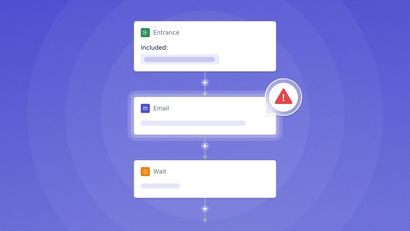
- Visual journey builder: Can you map branching, cross-channel flows without engineering time?
- Real-time segmentation: Do audiences update as behavior happens, not on a nightly batch?
- Cross-channel orchestration: Can one journey move fluidly across push, in-app, email, and SMS based on engagement?
- Personalization at scale: Dynamic content driven by attributes and events, not static templates?
- A/B and multivariate testing: Testing full journey paths, not just subject lines?
- Robust APIs: Does it plug cleanly into the rest of your data stack?
Run your current setup against this list honestly. Most platforms nail two or three; the gap is usually in orchestration and real-time actionability.
Building beyond one-off campaigns
Every stage of this playbook depends on the same thing: a platform that can act on behavior in real time, across channels, without someone manually triggering each send. That's what OneSignal's Journeys are for. Map the branching logic once (your welcome sequence, your behavior-triggered nudge, your win-back escalation) and it runs automatically for every user who fits, updating as their behavior does.
Get Started for Free