Most "best AI marketing tools" lists have a problem if you're running growth for a mobile app. They're either written for content marketers in general, so half the list is a blogging assistant and an SEO tool that have nothing to do with an app, or they're a shootout between five lifecycle platforms that all do the same thing and expect you to pick exactly one.
So instead of a ranking, here's a map: the jobs AI is now genuinely good enough to take off a mobile marketer's plate, organized by what each one actually does, plus where messaging itself fits into that stack. None of these compete with each other. Most teams will end up using more than one at the same time.
Canva Magic Studio: Creative production without a design queue
For creative production, Canva Magic Studio helps lifecycle marketers create first drafts of push notification images, in-app message visuals, App Store screenshots, and feature-announcement social posts. Its text-to-image, text-to-video, and AI copywriting tools support headlines and captions alongside visual assets. It is most useful for the steady volume of smaller campaign assets that lifecycle programs need each week.
AppTweak: Getting found before you have to pay for it
Paid acquisition gets most of the attention, but organic installs often begin when someone searches the App Store or Google Play for a specific need. AI-driven app store optimization tools identify search terms and listing changes to test, helping teams improve visibility in relevant app-store results. For teams evaluating AI marketing tools, this category supports app discovery rather than customer messaging. Stronger store listings can grow organic traffic and reduce reliance on paid acquisition.
OneSignal: Turning audience data into an actual message
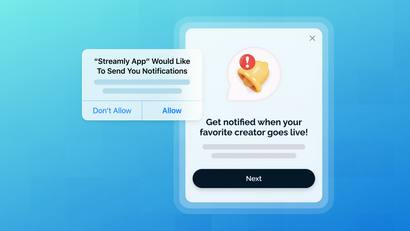
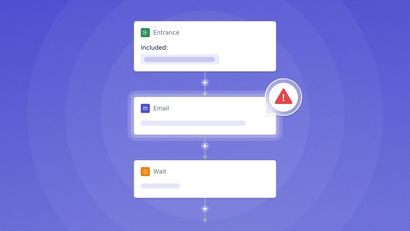
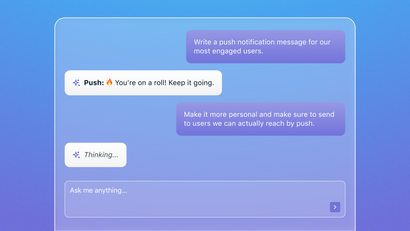
OneSignal is a customer engagement platform that sends messages based on audience segments and behavioral triggers. OneSignal AI lets marketers build segments, draft journeys, and review campaign performance using plain-language prompts instead of manual setup. The OneSignal MCP Server goes a step further, letting external AI assistants like Claude or ChatGPT operate OneSignal campaigns directly, with confirmation required before any message reaches real users.
Where the other tools on this list help marketers create content, get discovered, or understand their users, OneSignal is the autonomous lifecycle marketing platform that turns those inputs into a message that actually reaches someone, at the right moment.
AppFollow: Hearing what your users are actually saying, at scale
For teams evaluating AI marketing tools, this review-listening tool analyzes App Store and Google Play reviews to identify recurring themes. Marketers can spot a growing UX complaint or see where competitors' users describe needs their app already meets, then use those findings to prioritize lifecycle campaigns before retention suffers.
Julius AI: Answering your own data questions without a data team
Marketing teams without a dedicated analyst can use it to examine spreadsheet or campaign-export data in plain language. Teams can ask whether an App Store update changed retention or identify channels that underperform, then use the results to decide what to investigate next. It suits lean teams that need answers from existing data without building a full business-intelligence workflow.
All that work eventually needs somewhere to land
Each one of these tools is built for a specific job, creating assets faster, getting discovered, understanding what users are actually saying, or making sense of your own data. The real skill in 2026 isn't finding one AI tool that does everything, it's knowing which job you're solving for and reaching for the right one.
However good your creative, your ASO research, or your feedback analysis gets, it still has to turn into an actual message that reaches the right person at the right time.
If any part of your stack from this list ends in "now go build the actual message," that's where OneSignal fits in. Get started for free and see how much of that last step you can hand off.
Get Started for FreeFrequently asked questions
What AI tools should mobile marketers actually be using in 2026?
Look for tools that cover distinct jobs rather than overlapping ones: creative production, app store discovery, user feedback analysis, ad hoc data analysis, and lifecycle messaging are five real, separate needs, and there's no reason one tool should try to do all of them.
Do I need a different AI tool for every part of my marketing workflow?
Not every part, but the jobs that eat the most time with the least specialized skill required, like resizing creative or summarizing reviews, are the easiest ones to hand off first.
Is OneSignal an AI marketing tool?
It's an autonomous lifecycle marketing platform with AI built in. OneSignal AI handles campaign creation and analytics conversationally inside the platform, and the OneSignal MCP Server lets external AI assistants operate it directly, but its core job is still sending and orchestrating the message itself.
How do these tools work together instead of replacing each other?
Each one feeds the next: creative tools produce the assets, ASO and feedback tools inform what to say and to whom, analysis tools tell you what's working, and a messaging platform is what actually delivers it, so they function as a pipeline rather than competing options.