Choosing a messaging platform often means balancing campaign speed with governance, scalability, customer experience, and engineering capacity. This OneSignal vs Airship evaluation focuses on how each platform supports your specific lifecycle programs, rather than which vendor has the longest feature list.
OneSignal is worth evaluating for cross-channel engagement, accessible plan options, and fast implementation. Airship may fit highly resourced teams that run complex customer-experience programs.
OneSignal vs Airship at a glance
OneSignal is a customer engagement platform spanning mobile push, web push, email, in-app messaging, and SMS/RCS, with native segmentation, no-code Journey orchestration, and AI-driven personalization and automation built directly into the platform. Airship is a customer engagement platform covering journey orchestration, personalization, and messaging across channels like push, email, and SMS.
The full OneSignal and Airship comparison provides more detail on the summarized product and pricing distinctions below.
Use these criteria to evaluate a mobile messaging platform
A useful evaluation framework begins with reliability, scalability, rich-content support, platform coverage, customization, and cost.
These criteria connect technical capabilities to daily marketing work and customer outcomes.
Reliability and deliverability
An API acceptance response only confirms that a platform received a request. Your team also needs to know whether the notification reached the device and appeared to the recipient.
OneSignal’s Confirmed Delivery verifies that a push notification was delivered to and displayed on a user’s device. The OneSignal and Airship evaluation guide describes this distinction and the implementation considerations for both platforms.
During a vendor evaluation, ask how delivery is measured across operating systems, app states, and message types. Review how the platform handles invalid subscriptions, provider errors, expired credentials, and delayed delivery.
Your reliability requirements should cover:
- Device-level delivery confirmation
- Provider acceptance and rejection reporting
- Failure reasons and troubleshooting data
- Credential and certificate monitoring
- Subscription health and invalid-token handling
- Message throttling and retry behavior
Scalability, platform coverage, and rich content
Platform coverage should include the channels you use today and those you may coordinate later. Treating mobile push as an isolated tool can create fragmented identity data, campaign calendars, and reporting as your program expands.
The platform must also support the devices and environments in your product roadmap. Confirm support for each mobile operating system, browser, development framework, and app architecture that matters to your team.
Rich content affects what recipients can do from a message. OneSignal supports Deep Linking, which directs recipients to a specific app screen or web page through custom deep links and URLs. Its messaging documentation also covers platform setup, SDK integration, channels, and campaign capabilities.
Test rich content on physical devices. Preview tools help with composition, but device tests expose differences in operating-system versions, permission states, media rendering, and app routing.
Customization, workflow control, and cost
Evaluate customization through the data and controls available to your team. Relevant areas include audience attributes, behavior, message content, delivery timing, frequency rules, channel selection, and external integrations.
Workflow ownership matters just as much as feature availability. Determine which changes marketers can make directly and which require a developer, data engineer, or vendor support request. A technically possible workflow may still be impractical if routine adjustments enter a development queue.
Treat cost as total operating cost. Include:
- Plan availability and contract terms
- Channel, subscriber, or messaging charges
- Implementation and migration time
- Internal engineering and data work
- Support requirements
- Ongoing testing and maintenance
- Enterprise capabilities that your team will not use
This calculation helps prevent both underbuying and paying for scope that your current program cannot operate.
Compare channels and engagement capabilities beyond mobile push
Channel breadth has value when it supports a defined customer journey. A platform with many channels can still be a poor fit if it lacks the specific delivery controls, data connections, or operating workflow your team needs.
OneSignal channel coverage
OneSignal supports mobile push, web push, in-app messages, marketing and transactional email, SMS, RCS, and iOS Live Activities. Its channel overview for teams moving beyond basic push delivery explains how these capabilities fit a managed engagement platform.
OneSignal can send real-time updates to iOS Live Activities through its SDK and API. This supports use cases where information changes after the initial experience begins, such as an order status or live event update.
Channel selection should follow the customer’s context:
- Use mobile push for timely communication outside an active app session.
- Use web push when browser reach matters to your acquisition or retention model.
- Use in-app messages for contextual communication during an active session.
- Use email for detailed content, transactional records, and longer lifecycle messages.
- Use SMS or RCS where a text-message experience fits the customer’s consent and expectations.
- Use Live Activities when an iOS experience needs visible, changing information.
Airship channel coverage
Airship lists push notifications, SMS/RCS/MMS, email, and mobile wallet among its channels. It also presents mobile wallet as part of a broader customer-experience program.
The existing platform comparison lists mobile push, web push, in-app messaging, email, SMS, App Inbox, mobile wallet, and Live Activities for Airship. Treat those channel lists as a starting point for validation.
A channel name does not establish complete parity. Ask each vendor about message composition, automation, personalization, regional support, consent controls, analytics, and API access for that channel.
What channel breadth means for your lifecycle strategy
Map each required channel to a customer need before requesting a demo. Onboarding may combine an in-app prompt with follow-up email. Re-engagement may use push first and another consented channel if the recipient remains inactive.
Transactional updates require different controls from promotional campaigns. Delivery timing, deep links, event triggers, auditability, and failure handling may carry more weight than visual editing.
Ask these questions during channel selection:
- Do you need to reach customers on the web as well as in a mobile app?
- Do you need active-session in-app messages?
- Will email support marketing, transactional communication, or both?
- Does your consent model cover SMS text messages or RCS?
- Do customer experiences depend on mobile wallet passes?
- Do you need Live Activities for time-sensitive iOS updates?
- Does each channel use the same identity, segmentation, and reporting model?
How journeys, personalization, and experimentation differ
Journey tools become useful when they preserve behavioral context across channels. Your evaluation should follow one real workflow from audience entry to conversion reporting.
Build cross-channel Journeys without losing behavioral context
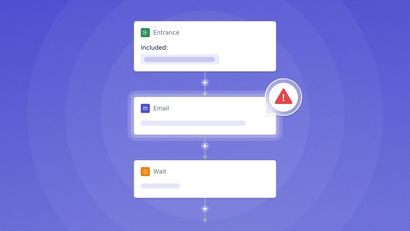
OneSignal automated Journeys enables no-code messaging journeys across channels for onboarding, retention, and re-engagement. A marketer can define entry conditions, delays, branches, and messages within an automated flow.
Consider a fictional onboarding Journey for a subscription app. A new user receives a welcome message, enters a segment based on setup progress, and receives a reminder if a required action remains incomplete. The Journey stops promotional follow-up after the user completes that action.
During a trial, test whether the platform can:
- Accept the required product event
- Update the user’s journey state promptly
- Branch based on behavior or profile data
- Coordinate more than one channel
- Prevent an irrelevant message after conversion
- Show why a user entered or left a workflow
Airship presents customer-journey orchestration and no-code experiences as platform capabilities. Ask its team to build the same workflow so you can compare the operating process rather than presentation materials.
Turn user data into relevant targeting
OneSignal Segments are dynamic groups based on criteria including behavior, location, Tags, and subscription status. Dynamic membership helps campaigns respond as customer data changes.
Tags are custom metadata attached to users. They can store preferences, behaviors, and other properties used for targeting. External ID links a OneSignal user to a company’s user system or database, which helps connect messaging activity to an established identity model.
Airship presents customer-data collection and hyper-personalization as platform capabilities. During evaluation, test how each platform ingests, updates, resolves, and removes customer data.
Use a sample dataset that includes anonymous visitors, signed-in customers, multiple devices, changed preferences, and inactive subscriptions. This reveals how identity rules behave under realistic conditions.
Measure and improve campaign outcomes
OneSignal supports A/B testing, detailed campaign analytics, Custom Outcomes, and Event Streams. Custom Outcomes measure custom conversion events, and Event Streams send real-time messaging events to external systems.
Airship presents experimentation, performance analytics, integrations, and real-time data streams as capabilities. Ask both vendors to show how a marketer creates a test, selects a success metric, reviews confidence, and applies the result.
Measurement should connect campaign activity to a business event. Opens and clicks can help diagnose message performance, but subscription activation, purchase, completed onboarding, or renewed engagement may better represent the intended outcome.
Compare implementation, integrations, and team workload
Implementation affects marketing speed, data quality, consent handling, and future maintenance. Marketing and engineering should evaluate the work together.
What developers need to implement
Both platforms require app registration with notification services such as Apple, Google, or Amazon. Developers must invoke the relevant SDK in the mobile or web app, then use the vendor console to send an initial notification.
OneSignal reports that its SDK takes about 15 minutes on average to implement for sending notifications. Treat that as a vendor-reported average rather than a guaranteed project timeline. Production implementation can also include identity mapping, event instrumentation, consent flows, deep links, analytics, and integrations.
OneSignal integrates with third-party tools, CRMs, and data pipelines through SDKs or webhooks. It also provides an API for automating messaging, managing users, and tracking delivery.
Use this implementation-evaluation checklist:
- Confirm SDK support for every application framework, operating system, and browser in scope.
- Review the certificate, key, and credential setup process for each notification service.
- Document API requirements for transactional sends, automation, user updates, and reporting.
- Map subscriber records, user identifiers, Tags, attributes, consent states, and suppression data for migration.
- Define an event taxonomy with clear names, properties, owners, and retention rules.
- Test consent prompts, subscription changes, preference updates, and opt-out behavior.
- Create a test plan for devices, operating-system versions, app states, deep links, and failure cases.
- Assign ownership for credentials, SDK updates, integrations, data quality, and incident response after launch.
What marketers need to operate
Marketers need direct control over routine work. Ask each vendor to demonstrate campaign creation, segmentation, Journey changes, testing, approvals, scheduling, and reporting with the roles your team expects to use.
Pay attention to the steps between an idea and a live campaign. A workflow that depends on repeated data requests or developer changes can slow response times, even when the underlying platform supports the use case.
InCrowd Sports considered Airship and selected OneSignal after evaluating documentation, SDK support, API usability, automation, and segmentation. The InCrowd Sports case study is a useful example of turning broad requirements into practical selection criteria.
Use the same method for your team. Identify the tasks performed each week, then ask a marketer to complete them during the evaluation.
How to assess ongoing maintenance
Initial setup is only part of the workload. Ongoing work may include SDK upgrades, provider credential renewal, event changes, broken webhook handling, data-quality reviews, template governance, and permission updates.
Airship may suit organizations with large budgets and dedicated engineering resources for longer setup and ongoing management. This is fit guidance, rather than a fixed implementation requirement for every Airship customer.
Estimate maintenance by assigning an owner and expected response process to each system component:
- Mobile and web SDKs
- Notification-service credentials
- APIs and webhooks
- User identity and profile data
- Event definitions
- Consent and preference data
- Templates and brand controls
- Campaign approvals
- Deliverability monitoring
- Reporting pipelines
A platform fits your operating model when ownership remains clear after the launch team moves to other work.
Pricing and plan transparency: compare the operating model
Published entry prices help with early screening, although they do not represent every team’s final cost. Channel use, message volume, support, implementation, and contract terms can change the operating total.
OneSignal plans and entry point
OneSignal has a Free Plan, Growth Plan, Professional Plan, and Enterprise Plan.
The Free Plan includes unlimited mobile push and in-app messaging for organizations with up to 1,000 monthly active users, plus web push notifications to up to 10,000 subscribers per send. Growth Plan pricing starts at $19 per month, with additional channel-usage costs. The Professional Plan and Enterprise Plan use custom pricing with volume-based discounting.
This structure allows teams to inspect an accessible entry point before discussing custom enterprise requirements. Confirm which features, usage allowances, service levels, and support options apply to your projected plan.
Airship’s sales-led pricing model
Airship does not offer a free plan. Its listed pricing starts at $25,000 per year, and prospective customers speak with sales for cost information.
For teams with fewer than 1 million monthly active users, one OneSignal estimate places Airship’s annual pricing at $25,000 to $75,000. The 2026 push-notification platform comparison describes this as an estimate within a fully custom, sales-led model, not a universal quote.
Ask Airship for a proposal based on your current volume and expected growth. The proposal should clarify channels, usage assumptions, support, implementation services, contract length, and overage treatment.
How to estimate the full cost of each option
Build a cost worksheet before comparing vendor proposals. Include:
- Required channels: Identify what must launch now and what may follow.
- Audience size: Record monthly active users, mobile subscribers, and web subscribers where relevant.
- Message volume: Estimate sends by channel and distinguish transactional from marketing use.
- Included capabilities: Map Journeys, segmentation, testing, analytics, data export, and governance requirements.
- Support requirements: Define response times, onboarding help, and technical-service expectations.
- Implementation labor: Include SDK work, migration, event instrumentation, testing, and training.
- Expansion costs: Model expected growth in subscribers, messages, channels, and internal users.
Avoid reducing the decision to a published starting price. A lower entry point can still lead to unexpected costs if usage assumptions are incomplete. A custom contract may also include scope your team does not need.
Which platform fits your team and goals?
The better fit depends on your channels, operating model, engineering resources, measurement requirements, and budget process.
Choose OneSignal when speed and accessible engagement tooling matter
Evaluate OneSignal first when mobile push or web push anchors your program and you also need coordinated cross-channel messaging. Its documented capabilities include no-code Journeys, dynamic Segments, Tags, A/B testing, campaign analytics, Custom Outcomes, and Event Streams.
OneSignal is also relevant when your team needs an accessible plan entry point or wants to test implementation without beginning with an enterprise sales process. The fit becomes stronger when marketers need to own routine segmentation, workflow, and campaign work.
For a push-only use case, confirm that you still have the required delivery measurement, identity controls, APIs, deep links, and reporting. A narrowly defined channel requirement can still involve substantial operational detail.
Choose Airship when scope and resources are the priority
Evaluate Airship first when a highly resourced organization needs a broad customer-experience platform. Airship presents listed channels, mobile wallet, customer-data capabilities, journey orchestration, experimentation, no-code experiences, and hyper-personalization as part of that scope.
That breadth may fit a mature program with dedicated marketing operations, data, procurement, security, and engineering resources. Ask the vendor to show how those teams collaborate inside the platform and which dependencies remain outside it.
Confirm that the organization can use the proposed scope. Enterprise functionality has limited value when the team lacks the data, ownership, or campaign capacity needed to operate it.
Avoid choosing on feature checklists alone
A feature checklist establishes eligibility. It rarely shows how the platform works with your data, staff, approval process, or reporting model.
Use this decision tree:
- Start with channels: List the channels required for current and planned use cases.
- Assess team resources: Identify engineering, data, marketing-operations, security, and procurement capacity.
- Assign workflow ownership: Decide who creates segments, launches Journeys, changes campaigns, and reviews results.
- Define measurement: Specify how you will verify delivery, engagement, retention, and conversion.
- Map integrations: Document identity systems, product events, CRMs, analytics tools, and data pipelines.
- Set budget requirements: Decide how much pricing visibility procurement needs before vendor discussions.
Choose the platform that can execute your highest-value workflows within those constraints.
When to shortlist Airship alternatives
Teams should investigate Airship alternatives when pricing transparency, channel priorities, implementation capacity, analytics, governance, or data architecture do not align with the initial two-vendor shortlist.
Signals that it is time to expand the shortlist
Expand your evaluation when neither platform fits the required operating model. Common signals include:
- The available channels do not match your lifecycle priorities.
- Delivery reporting does not satisfy your reliability standard.
- Marketers cannot own the workflows they need to change frequently.
- Your identity or event architecture requires extensive custom work.
- Procurement needs more pricing visibility before engaging sales.
- Governance, security, or approval controls do not match internal policy.
- The implementation requires more engineering capacity than your roadmap allows.
- Analytics cannot reproduce the metrics used to judge campaign impact.
OneSignal, Braze, CleverTap, MoEngage, and Firebase Cloud Messaging are examples that teams may encounter in the broader mobile-engagement market. This is a starting set for research, not a ranking.
Build a focused evaluation list
Keep the shortlist small enough to test properly. Include vendors that meet your non-negotiable channel, security, integration, and budget requirements.
For each shortlisted option:
- Use the same written requirements.
- Provide the same sample workflow and dataset.
- Ask vendors to demonstrate the same delivery and conversion metrics.
- Record implementation dependencies and ownership.
- Request pricing against the same audience and usage assumptions.
- Score evidence from the demo or trial, rather than sales claims alone.
A repeatable process produces a more defensible choice than a broad alternatives roundup.
What to evaluate before switching push-notification providers
A provider switch affects subscriptions, consent, identity, SDK behavior, automation, and historical reporting. Define the migration around measurable use cases rather than a longer feature list.
Audit your current messaging program
Create an inventory before changing SDKs or exporting data. Document:
- Current subscription and consent records
- User identity mapping across devices and channels
- Tags, attributes, preferences, and profile fields
- Active and saved segments
- Event names, definitions, and properties
- Message templates and reusable content
- Deep links and app-routing rules
- Frequency controls and suppression logic
- Campaign and Journey history
- APIs, webhooks, CRMs, and data pipelines
- Dashboards, exports, and reporting requirements
Mark each item as transferable, rebuildable, replaceable, or no longer needed. This prevents obsolete workflows from shaping the new implementation.
Validate migration and measurement
Define the metrics that must survive the migration. These may include delivery, opens, clicks, completed onboarding, retained activity, purchases, or other conversion events.
OneSignal Custom Outcomes can track custom conversion events and measure campaign impact. Test whether the destination platform can preserve or rebuild the metrics your team uses for engagement, retention, and conversion.
OneSignal also supports Confirmed Delivery as verification that a notification reached and displayed on a device. Set an equivalent delivery-validation requirement for every provider under consideration, even if the vendor uses different terminology.
Review historical reporting separately from future measurement. Decide whether old campaign data must remain queryable, move to a warehouse, or stay in a read-only system.
Run a controlled proof of concept
Use a limited audience and a defined campaign before committing to a full migration.
- Migrate a small, representative audience with identity, subscription, consent, and attribute data.
- Validate SDK behavior across supported devices, app states, and operating-system versions.
- Test opt-in, opt-out, resubscription, and preference-management flows.
- Verify deep links, templates, rich content, and personalization with realistic data.
- Confirm provider acceptance, device delivery, and custom conversion measurement.
- Compare how marketers create audiences, launch messages, change workflows, and interpret results.
- Document defects, manual work, missing data, and support dependencies.
- Plan a phased rollout with monitoring, rollback criteria, and clear ownership.
Define success criteria before the proof of concept begins. This keeps the decision tied to customer experience and operating performance.
Make the decision based on fit, not feature volume
Compare OneSignal and Airship through five practical areas: required channels, reliable delivery and measurement, journey and personalization workflow, implementation capacity, and pricing model.
OneSignal is relevant for teams seeking documented push-first and cross-channel engagement capabilities with accessible plan options. Airship is relevant for organizations equipped to operate a broader enterprise customer-experience platform.
Create a written requirements list, involve both marketing and engineering, and validate the highest-risk workflow in a demo, trial, or proof of concept. Choose the platform your team can implement, measure, and operate consistently.
Get Started for Free