Think about the last time you had to make a purchase decision you really didn’t want to get wrong. You’ve tried every keyword tangent, opened countless tabs, compared options, and tried to stitch together some form of clarity from fragments.
That maze is disappearing. Not someday… now.
The shift from searching to asking
Conversational AI-driven search has changed the starting point. Customers don't "search." They ask, in their own words.
Instead of guessing keywords and navigating menus, they say what they mean: "I need a waterproof winter jacket that isn't bulky, under $100." Or "Which plan is best if I travel monthly and hate foreign exchange fees?"
A good system responds like a helpful guide: it clarifies, narrows, recommends, and helps the customer decide inside a single thread.
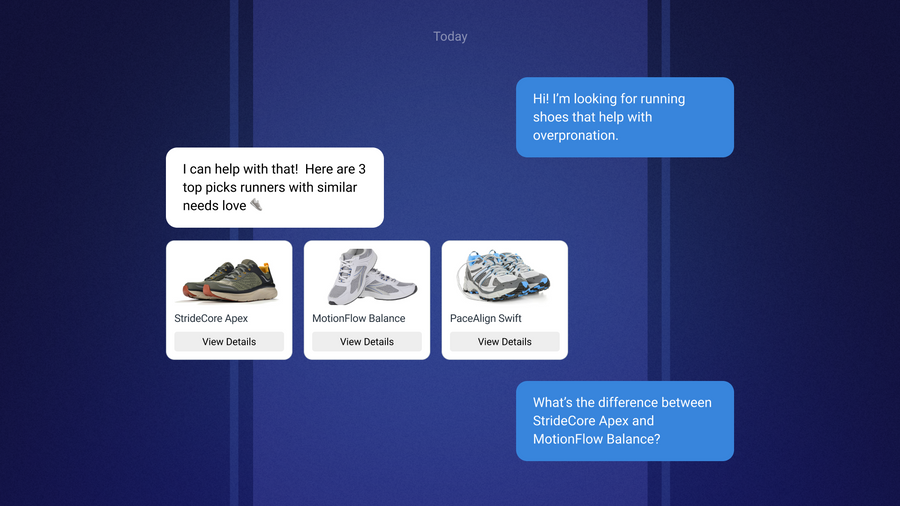
Consider what happens when a customer messages a brand about running shoes for overpronation in their size and budget. The assistant asks one follow-up about terrain preference, shows three options with clear differences, and offers one-tap checkout. What used to require browsing multiple sites and reading dozens of reviews now takes three minutes in one conversation.
Why this is happening right now
This shift feels inevitable because multiple things clicked into place at once.
People think in natural language. When people are on mobile, rushed, or unsure, they don't want to translate needs into filter logic. A parent in a taxi types "gift for a 9-year-old who loves science, under $30, arrives by Friday" and gets curated options immediately, not a category page with 847 results.
Expectations moved from results to resolution. Customers don't want more links. They want the next step to be obvious. A traveler asks "does this hotel have late check-in and parking?" The assistant answers, confirms policy, and offers booking with the right room type selected.
Conversations adapt faster than navigation. Menus require you to predict the path. Conversations discover the path. Someone starts with "noise-canceling headphones for travel" and two questions later realizes they actually need 30+ hours battery life, foldable design, and comfort for long flights. The conversation helped them figure out what they wanted.
Trust needs room to breathe. The moment before purchase is full of "wait, but..." questions. Conversations let customers ask without friction. A shopper wonders if something is returnable if it doesn't fit. The assistant surfaces the return policy and a fit guide right when doubt shows up, not buried in footer links.
This is about engagement, not just search
Conversational search doesn't only improve discovery. It changes how customers engage with your brand.
Intent becomes something you shape, not something you guess. Traditional search tries to interpret. Conversational search helps customers clarify what they actually want. A customer asks for "a simple phone plan" and the assistant learns they're streaming daily on public transit. It recommends unlimited with hotspot, not the cheapest option that will frustrate them in two weeks.
Every customer gets a path that fits their context. One experience doesn't work for everyone. Conversations adapt naturally. A customer on a lunch break gets "top 3 choices, fastest decision." A customer at night with more time gets deeper comparison, reviews, and detailed specs. Same question, different context, better outcome.
Discovery, support, and conversion can live in one thread. When context persists, customers don't restart every time. A customer asks about a product Monday, pauses to check with their partner, then returns Wednesday. The assistant remembers the shortlist and picks up exactly where they left off.
What conversational discovery looks like in practice
The pattern is consistent across industries: faster clarity, fewer steps, more confidence.
In retail, a customer asks for running shoes for overpronation. The assistant recommends three options, explains differences in stability features, shows reviews from similar runners, and completes checkout in chat. No tab switching, no cart abandonment.
For travel and local services, a customer needs a dentist near their office this week, English-speaking, with evening availability. They see available slots and book without calling multiple offices or checking separate calendars.
In fintech, a customer asks which plan is best if they travel monthly. The assistant compares two plans in plain language, explains trade-offs, and estimates monthly savings based on their stated habits. The decision becomes clear.
For telecom support, a customer asks why their data keeps running out. The assistant highlights what's consuming data, suggests an upgrade aligned to their actual usage, and activates it immediately. One conversation replaces three support calls.
In healthcare information, a patient asks what lab tests they should do before pregnancy. They receive a checklist with brief explanations, typical timing, and a booking flow that connects to nearby labs.
In B2B software, a prospect needs lifecycle messaging without heavy engineering. The assistant provides a relevant use case, implementation timeline, and proof points from similar companies, then offers a handoff to a specialist for complex requirements.
A new funnel: from clicks to completion
Traditional funnels optimize for traffic and clicks. Conversational funnels optimize for finishing.
Here's the structure that's emerging across successful implementations.
Ask. The customer states what they need in plain language. "I need a jacket for cold winters, waterproof, not bulky." No keyword translation required.
Clarify. A few lightweight questions uncover constraints. "Do you prefer down or synthetic insulation? What temperature range?" These questions feel helpful, not interrogative.
Recommend. Ranked options with clear reasoning. "These three fit your temperature range and weight preference. Here's what's different about each." Transparency builds trust.
Prove. Evidence appears at the moment of doubt. Verified reviews from similar buyers, return policy details, and delivery date confirmation appear right before checkout. Doubt dissolves when proof arrives exactly when needed.
Act. The next step happens inside the thread. Buy now, book a slot, upgrade a plan, or escalate to a human specialist. Every extra navigation point you add cuts completion rates.
What customer engagement teams need now
Conversational search requires new capabilities, not just a new tool.
Conversation design becomes a growth lever. Timing, tone, and the order of questions shape outcomes. Ask for an email too early and people drop. Ask after delivering value like a curated shortlist with rationale, and opt-in rates rise. The structure of the conversation directly impacts conversion.
Real-time orchestration matters. Answers aren't enough. The thread should complete actions. After "book a dentist," the assistant shows available times and confirms the appointment. It doesn't send someone to a separate booking page and hope they complete.
Zero-party data becomes more valuable. Customers volunteer what matters if the experience feels helpful and respectful. A shopper says "no fragrance, sensitive skin" and that preference makes the next recommendation instantly better without invasive tracking.
Measurement needs an upgrade. Track outcomes that reflect real value: completion rate, time to resolution, conversion, satisfaction. Watch where people stall. "I'm not sure about sizing" is a signal to improve fit guidance inside the conversation.
Trust and compliance must be designed in. Clear disclosures, minimal data collection, secure flows, and easy human handoff. For account changes, verify identity. For general questions, stay lightweight. Privacy isn't a feature you bolt on. It's how you build the experience.
Why messaging channels and RCS are uniquely positioned
RCS is becoming a natural home for conversational discovery because it's built for richer, more actionable conversations.
Rich interactions make decisions easier. Buttons, suggested replies, carousels, and media reduce friction. A customer compares three plans side by side in a carousel, then taps "Activate" without leaving the thread.
Persistent threads support real life. People pause, return, and continue without restarting. A customer starts an order during their commute, comes back at home, and finishes with the same context intact. Life is asynchronous. Messaging should be too.
Messaging often signals higher intent. Starting a conversation is a deliberate move. Instead of browsing, a customer messages "can you deliver tomorrow?" That's purchase intent asking for confirmation, not curiosity.
Operational payoff is straightforward. Fewer steps usually means fewer drop-offs. If upgrading a plan happens in-chat, you avoid login loops, page loads, and abandonment points. Simplicity converts.
The realities we need to design for
This only works if we're honest about the hard parts.
Wrong answers are unacceptable in sensitive flows. Ground responses in trusted sources. Escalate when uncertain. If a customer asks about a medical claim, share safe guidance and route to a professional instead of guessing. Humility builds trust more than false confidence.
Brand voice can drift without guardrails. Tone systems aren't optional. Ten thousand conversations happening simultaneously still need to sound like one company: clear, calm, consistent. Your brand worked too hard to let automation dilute it.
Privacy must be earned. Collect less. Explain more. Give control. A customer should be able to say "forget my preferences" and see it happen immediately. Transparency isn't compliance theater. It's respect.
Over-automation creates frustration. Make human support obvious and easy. If a delivery issue is complex, one tap connects to an agent with the conversation history already attached. The goal isn't to eliminate humans. It's to use automation for what it does well and humans for what they do well.
Chat fatigue is real. A great conversation is short. It solves the problem. Instead of ten back-and-forth messages, use one clarifying question and a three-option recommendation. Efficiency shows respect for people's time.
How to prepare in the next 90 days
You don't need to overhaul everything. You need one high-value pilot.
Weeks 1 through 2: Find your top discovery questions. Use site search logs, support tickets, sales transcripts. Look for patterns. "Which plan do I need?" "Will this work with my device?" "How long does shipping take?" These represent proven demand.
Weeks 3 through 4: Pick three journeys with clear intent. Product finder, booking, upgrade, troubleshooting. Turn "find the right plan" into a short guided conversation with single-tap activation. Focus on high-friction moments with obvious value.
Weeks 5 through 6: Build the conversation architecture. Define intents, entities, constraints, fallbacks. If users say "not bulky," map what that means in your context: weight range, fit type, insulation style. Clarify how you'll ask about it naturally.
Weeks 7 through 8: Set trust boundaries. Decide what's safe to automate, what needs verification, what needs a human. Billing changes require identity verification. Shipping questions don't. Build these guardrails before you need them.
Weeks 9 through 10: Launch and measure behavior. Track completion, drop-off moments, satisfaction, conversion. If most drop-offs happen at delivery date questions, move delivery guarantees earlier in the flow. Real behavior teaches you what planning can't.
Weeks 11 through 12: Add trust signals inside the conversation. Show policies, verification, reviews, guarantees, and order status when they matter. At checkout hesitation, surface return policy and delivery date confirmation in the same thread. Context-aware reassurance reduces friction.
The brands that win will feel like guides
Conversational search isn't a feature you tack on. It's an experience layer that replaces friction with guidance.
The winners won't do AI for its own sake. They'll remove friction, build confidence, and help customers finish what they started with clarity and respect. Every interaction will feel like getting advice from someone who understands both your constraints and your goals. Someone who remembers what you said five minutes ago. Someone who can take action on your behalf. Someone who makes the complex feel simple.
Start small. Audit your top discovery moments this week. Ask one question: where could a conversation replace a maze? Pick one journey and pilot it in messaging this quarter.
Your customers are already asking. Make sure you're there to answer.
Start building where your customers already are
If you're ready to move discovery and engagement into one seamless thread, OneSignal can help. We enable growth teams to launch RCS quickly, design richer in-thread journeys, and orchestrate messaging across channels so high-friction moments become effortless interactions.
The brands that win next won't be the ones who shout the loudest. They'll be the ones who listen best and respond smartest, in real time.
Reach out and we'll show you what an end-to-end RCS experience looks like for your business, including the exact journeys to pilot first.